 IT
IT EN
EN
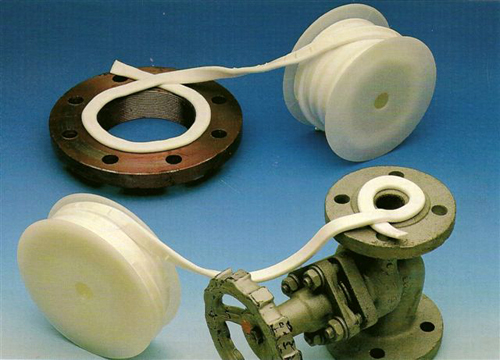
Flangiflon is an expanded PTFE gasket produced by uniaxial extrusion. This orientation gives the PTFE fiber structure excellent longitudinal stability during extrusion. Compressing Flangiflon results in a change in thickness and a diffusion of the product, ensuring an excellent seal. Flangiflon is supplied with double-sided tape for easy positioning on sealing surfaces and subsequent assembly.
Flangiflon is produced in various cross-sections, thicknesses, and lengths and wound on reels. Installing Flangiflon begins with selecting the correct cross-section. The sealing surface must then be cleaned and the protective paper removed from the double-sided tape. The two ends of the Flangiflon must then be overlapped and cut approximately 2 cm from the joint. The sealing surfaces are then sealed by tightening the bolts or screws symmetrically. Even in the case of severe damage to the sealing surface, a hermetic seal can be ensured by applying an additional layer over the damaged or damaged area. To prevent flange deterioration (as can happen with thin flanges), a "snake" application of the tape is recommended. This application method is also recommended for fragile flanges, such as those made of glass, ceramic, or plastic.
Flangiflon finds universal use as:
| Belt width mm | Width after compression of 100 Kp/cm2 | Thickness after compression of 100 Kp/cm2 | Width after compression of 200 Kp/cm2 | Thickness after compression of 200 Kp/cm2 | Roroli m |
|---|---|---|---|---|---|
| 3x1.5 | 3.5 | 0.5 | 4.5 | 0.4 | 30 |
| 5x2 | 6.0 | 0.7 | 8.0 | 0.5 | 20 |
| 7x2.5 | 8.0 | 1.1 | 9.5 | 0.7 | 15 |
| 10x3 | 11.5 | 1.3 | 14.0 | 0.8 | 10 |
| 12x4 | 13.2 | 1.4 | 17.0 | 0.9 | 10 |
| 14x5 | 15.0 | 1.5 | 20.0 | 1.0 | 5 |
| 17x6 | 19.5 | 2.0 | 25.0 | 1.2 | 5 |
| 20x7 | 23.0 | 2.6 | 30.0 | 1.8 | 5 |